
This post contains product affiliate links. These are mainly on items/hotels/tours that I personally endorse & love. I may earn a small commission if you make a purchase, but at no extra cost to you.
Sim Local is my top pick for staying connected in Greece. I’ve used it firsthand, so read my full review and grab 10% off with a discount code.

I am convinced I am going to retire to Greece. I can just imagine living by the coast, sipping floral white wines and tucking into crispy calamari as the waves roll in. Hey, I can dream, right?
Until that dream becomes a reality, I often travel to Greece to get my fill. Whether it’s island hopping or exploring places like Rhodes, there is just so much to see and do in this country. Luckily, I am always connected in Greece so I can tell all my friends, family and followers about how much I love the place (sorry to keep banging on about it!)
The way I do that without paying a fortune in roaming charges? An eSIM. Unlike a traditional SIM card, an eSIM (embedded SIM) is built directly into your phone and can be activated digitally in minutes. I remember years ago trying to buy a local SIM card in Corfu and nowhere being open on a Sunday. Well, those days are in the past now. You simply buy a plan online, scan a QR code, and you’re connected before you’ve even packed your bag.
I’ve been using eSIMs on my travels for a few years now, and they’ve completely changed how I stay connected abroad. On my most recent trip to Greece, I used Sim Local and I thought they were excellent. I never had any dropouts in signal, even when hiking in remote areas on the islands. Also, I churned through a lot of data uploading photos and videos to Instagram on the go. It’s all part of the job, I promise!
If you want the same hassle-free experience, read on. I’m breaking down everything you need to know about Sim Local’s eSIM for Greece – including how to get 10% off with my discount code ADVENTURE.
Contents:
Who are Sim Local and why are they good?

im Local has quietly become one of the most reliable options on the market for travellers. They operate in over 150 destinations worldwide, and what sets them apart isn’t just the breadth of coverage, it’s the quality of the networks they tap into.
A lot of budget eSIM providers cut corners by connecting you to a single, often weaker, local network. Sim Local is different. In Greece, your eSIM connects to Wind, one of the country’s major networks, giving you solid, dependable coverage wherever you are. On the mainland, in the Cyclades, in the middle of a ferry crossing, it consistently held a strong signal. That reliability is genuinely impressive and perfect for travellers like me.
They’re also completely transparent about pricing, with no hidden fees or surprise throttling buried in the small print. You pick a plan, pay once, and that’s that. For a travel blogger who’s been stung by dodgy providers before, that kind of clarity is worth its weight in gold.
There’s also a handy Sim Local app where you can monitor your data usage, manage your eSIM, and even purchase top-ups if you burn through your allowance faster than expected. It’s genuinely a really useful app that actually works.
How does Sim Local eSIM work?
The process is refreshingly simple, and once you’ve done it once you’ll wonder why you ever bothered with physical SIM cards.
Step 1 – Check compatibility. Most modern smartphones – iPhone XS and later, Samsung Galaxy S20 onwards, Google Pixel 3 and later – support eSIM. Sim Local has a compatibility checker on their site if you’re not sure. Your phone also needs to be unlocked (i.e. not locked to a specific carrier).
Step 2 – Choose your plan. Head to simlocal.com and search for Greece. You’ll see a range of plans based on data allowance and duration. Pick the one that suits your trip length and usage habits.
Step 3 – Purchase and receive your QR code. Once you’ve paid, Sim Local emails you a QR code almost immediately.
Step 4 – Install the eSIM. On iPhone: go to Settings > Mobile Data > Add eSIM > Use QR Code. On Android, it’s a similar process through Settings > Connections > SIM Manager. The whole installation takes about two minutes.
Step 5 – Set it live. You can install the eSIM before you leave home and simply switch it on when you land in Greece. Your UK number stays active on your primary SIM, so you won’t miss any calls or messages while you’re away. Just a quick note: make sure you switch off data roaming on your primary SIM so you don’t get charged double for using it while away.
That’s genuinely it. I had mine installed the evening before flying out to Athens, turned it on when the plane wheels hit the runway, and was connected before I’d even reached baggage.
Coverage: Where does Sim Local work?
Greece is a country of contradictions when it comes to connectivity. Athens and Thessaloniki have excellent 4G and growing 5G coverage; you’ll stream and browse without a second thought. The popular islands like Santorini, Mykonos, Crete, and Rhodes are equally well-served, with strong 4G across most of the tourist areas.
Where things get more interesting is the smaller, quieter islands and the rural interior. Signal can get patchy in very remote spots – think mountain villages inland or the tiny islands that don’t see many visitors. This is where having a reliable network like Wind makes a genuine difference. In my experience, even in those harder-to-reach corners of Greece, I was still able to get a usable signal more often than not, which is not something I would take for granted with every provider.
When I was exploring the remote island of Tinos, I was pleasantly surprised to find I still had a workable 4G connection most of the time. On the ferry between islands, signal held up well enough for messaging and light browsing, which is more than I can say for some European eSIMs I’ve tested that dropped to nothing the moment I was more than a mile offshore.
If you’re staying in Athens or the main tourist islands for the entirety of your trip, you’ll have zero complaints. If you’re venturing further afield, Sim Local is still comfortably the best eSIM option for Greece thanks to that reliable Wind connection.
Sim Local pricing and data plans
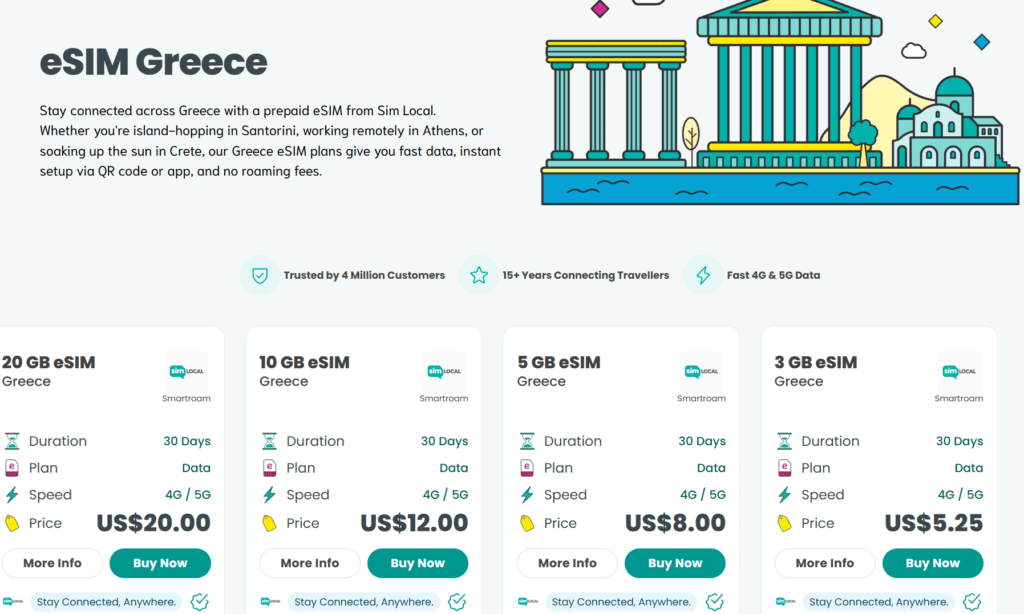
Sim Local’s Greece plans are competitive, particularly when you factor in the network coverage you’re getting. Here’s a rough guide to what to expect:
| Plan | Data | Validity | Approx. Price |
| Light | 3 GB | 30 days | US$8.75 |
| Standard | 10 GB | 30 days | US$19.50 |
| Heavy User | 20 GB | 30 days | US$21.50 |
Unlimited Data Plans for Greece
- Unlimited PRO 7 Days 10GB full-speed data per day: US$23.50
- Unlimited 7 Days 5GB full-speed data per day: US$18.75
The difference between these two plans is the amount of high-speed data available each day. For example, if a customer uses all 10GB of high-speed data included in Unlimited PRO in a single day, they can continue using data at a reduced speed. After 24 hours, the daily 10GB high-speed allowance resets automatically.
For most holidaymakers spending a week in Greece, the 10 GB plan is the sweet spot. It’s more than enough for daily maps, social media, messaging, and the occasional streaming session on a ferry. If you’re a remote worker, a heavy social media user, or planning to use your phone as a hotspot for a laptop, I’d go straight to 20 GB and not look back.
One thing I appreciate about Sim Local is that they don’t offer meaningless “unlimited” plans with hidden throttling. You know exactly what you’re getting. And with my discount code ADVENTURE, you’ll get 10% off any Greece plan. You can see all the options HERE.
My experience: 1 week in Greece with Sim Local

I’ll be honest, I have used Sim Local a few times already in the past, so I knew what to expect when visiting Greece. Saying that, I was really surprised at how good the connectivity was on the islands.
I flew into Athens and had a few days in the city before island hopping. From the moment I cleared customs, the Sim Local eSIM kicked in without any drama. Maps loaded instantly as I navigated the metro. I found myself wandering around Monastiraki and the Plaka with my phone confidently guiding me through the maze of streets. No signal drops, no buffering, no “searching for network” panic.
The real test came on the islands. I took a ferry over to Andros and, despite what I’d half-expected from previous experiences with eSIMs on island routes, the signal held up almost the entire crossing. Once on the island, connectivity was brilliant. It was easily fast enough that I was uploading photos to Instagram in real time from Chola while watching the sunset. (Priorities, obviously.)

I also used the hotspot function to tether my laptop for a couple of hours on a quiet afternoon, and it handled it without a flicker. Speeds were consistent and fast enough for emails, light work, and a video call home. I burned through maybe 6–7 GB across the whole week.
The Sim Local app was very useful too. I checked my remaining data each morning, and the interface was clean and simple. When I got home, I just switched back to my UK SIM and the Sim Local eSIM sat dormant, ready for next time.
For Greece specifically, where you’re often moving between islands, jumping on and off ferries, and exploring spots where a single-network eSIM might struggle, having a strong network like Wind behind your eSIM is a real advantage. I’ve used enough patchy eSIMs in Europe to know the difference, and this one actually worked.
If you’re planning a trip to Greece, whether it’s a city break in Athens, a week in Crete, or a full island-hopping adventure, I wouldn’t hesitate to recommend Sim Local. Grab your plan at simlocal.com and use code ADVENTURE for 10% off.