
This post contains product affiliate links. These are mainly on items/hotels/tours that I personally endorse & love. I may earn a small commission if you make a purchase, but at no extra cost to you.
Thinking of learning Spanish in Valencia? Here’s why it beats Madrid and Barcelona on cost, accent, climate and everyday student life.
There’s no faster way to learn a language than living and completely immersing yourself in it. Classroom hours matter, but the real progress happens when you’re ordering a coffee, working out a bus timetable or trying to follow directions from a bloke you’ve just stopped on the street.
I’ve spent a lot of time in Spain over the years, and I always slip into the same pattern. The first few days speaking Spanish are hard work. Then, something clicks and suddenly you’re following conversations you’d have completely missed at the airport.
When I visited Valencia, I found I slipped into my best Spanish at a bar near the City of Arts and Sciences. Okay, so it was 1am and I was feeling pretty loose. Oh, and I had a friend with me from Valencia who steered the conversation. But everything seemed to come together and I actually followed what was going on. I found it so much easier speaking Spanish to someone I didn’t know as opposed to using an online class or an app. You’ve got to experience it, to live it. That’s how we learn.
Most people default to Madrid or Barcelona when they start looking at Spanish courses, and I understand why. They’re both amazing cities. But if you actually sit down and compare what you get for your money, your time and your effort, Valencia makes a far stronger case than either of them.
Below I’ve broken down what a month in Valencia actually costs, why the accent is easier to get to grips with than Madrid’s or Barcelona’s, what the language schools are like, and the practical side of visas, timing and where to base yourself.
Valencia, Madrid and Barcelona at a glance
Here’s how the three cities stack up for anyone booking a Spanish course.
| Valencia | Madrid | Barcelona | |
|---|---|---|---|
| Room in a shared flat | €350 to €550 a month | €500 to €800 a month | €500 to €800 a month |
| Monthly budget, all in | €750 to €1,050 | €1,000 to €1,400 | €1,000 to €1,400 |
| Everyday language | Spanish, with Valencian co-official | Spanish | Spanish and Catalan side by side |
| Accent for beginners | Clear and unhurried | Standard Castilian, spoken fast | Clear Spanish, often Catalan-inflected |
| Size and getting around | Compact, walkable, excellent for cycling | Sprawling, you’ll rely on the metro | Dense and walkable, but crowded |
| Beach | Twenty minutes by tram | None, roughly 350km inland | In the city, packed in summer |
| Best for | Cost, immersion and outdoor life | A neutral accent and serious nightlife | Big-city energy, coast and mountains |
Rents and budgets are 2026 student averages and they’ve been climbing, so treat them as a starting point rather than a quote.
Your money goes a lot further here
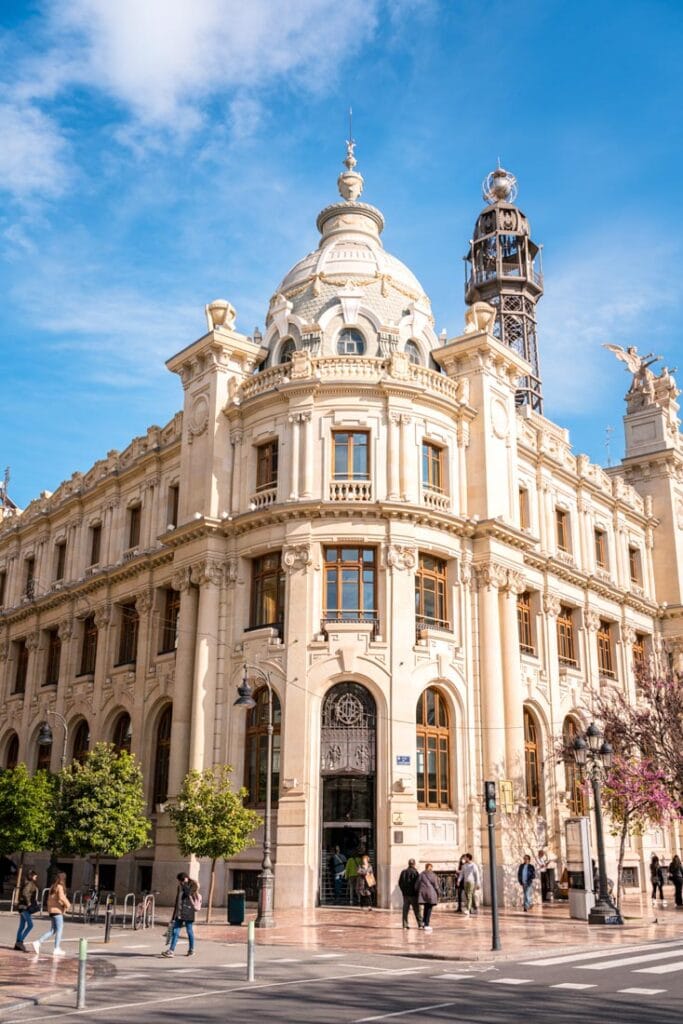
Valencia is noticeably cheaper than Madrid or Barcelona, and across a three-month course that difference adds up to real money. Rent is the biggest gap, but you’ll feel it in the weekly shop, in transport, and in the price of a menú del día, which in plenty of neighbourhood spots still lands around €13 to €15 for three courses and a drink.
That gap changes what a stay actually looks like. Rather than budgeting hard and staying in, students can afford to eat out, travel at weekends and say yes to things. Which, conveniently, is exactly the behaviour that gets you speaking Spanish faster. You know it makes sense!
It’s a city you can walk across
Valencia is compact in a way the two bigger cities simply aren’t. You can cross the centre on foot in about half an hour, so most students end up doing daily life by walking rather than commuting. It’s still a proper city though, with a population of around 800,000. Supermarkets, gyms, hospitals, bike shops and a large international airport are all here.
When you do need to cover ground there’s a metro, tram and bus network, plus Valenbisi bike hire and roughly 200km of cycle lanes. The metro runs from the city centre out to the airport in about 25 minutes.
For me, I loved how walkable Valencia was. I even ran through the park in the centre of the city a few times. And getting out to the beach is very easy too. All in all, it’s a really easy city to get around.
The Spanish you’ll hear is clear and easy to follow

This might not be one that you’ve considered before. Spanish is spoken here at a fairly even pace and with clear pronunciation, without the dropped consonants you’ll meet in Andalusia or the speed of Madrid. When you’re still translating in your head, that makes an enormous difference.
Valencia does have its own co-official language, Valencian, which is a variety of Catalan. You’ll see it on street signs and hear it more in the towns around the city. In Valencia itself though, Castilian Spanish is what you’ll get in shops, bars and everyday conversation, so beginners aren’t splitting their attention between two languages.
The schools are built around real conversation
The other reason students head here is the quality of the teaching. Valencia has a well-established cluster of language academies, several of them accredited by the Instituto Cervantes, running everything from two-week intensives to full academic years.
The good ones understand that classroom hours only take you so far. The Españolé courses in Valencia pair traditional teaching with a daily programme of social activities and real-world practice, so students are using what they’ve just learned in actual conversations rather than only in exercises.
Whichever school you go with, ask about class sizes and how much speaking time you’ll genuinely get before you hand over any money.
There’s plenty to do when you’re not in class

Days off are so easy to fill. El Carmen, the oldest part of the city, is a knot of narrow streets and small bars, with Valencia Cathedral at its heart and a chalice inside that’s long been claimed as the Holy Grail. The Mercado Central round the corner is one of Europe’s largest fresh produce markets and worth an hour even if you’re not buying.
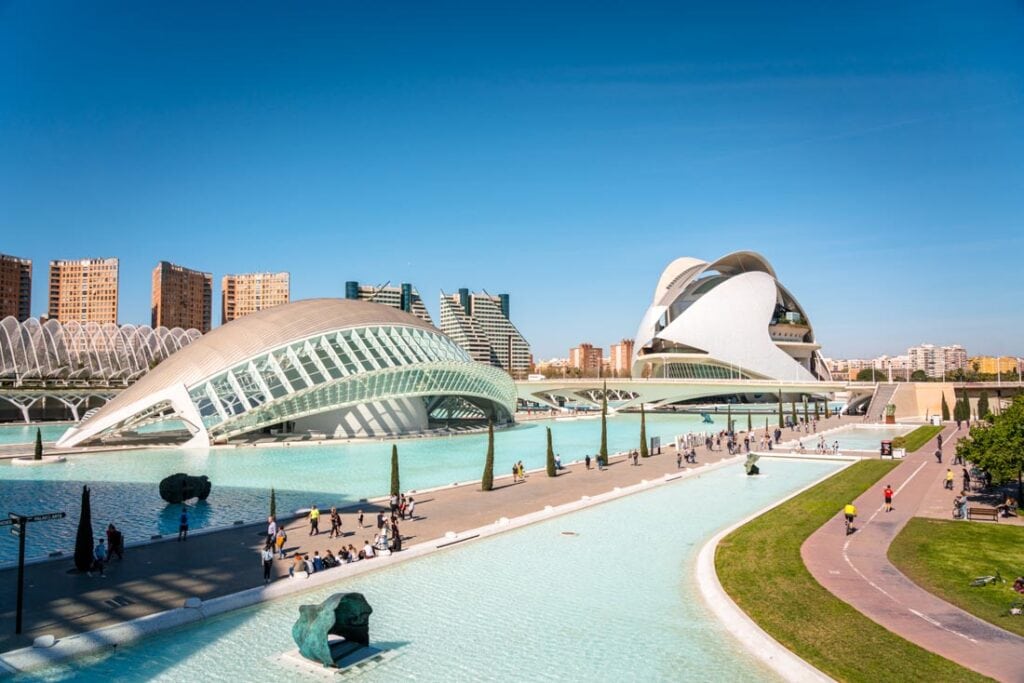
At the other end of the old riverbed sits the City of Arts and Sciences, Santiago Calatrava’s white, sci-fi complex of museums, an aquarium and an opera house. Beyond the landmarks there’s a constant run of exhibitions, gigs and festivals, and Las Fallas takes over the entire city every March.
The climate and outdoor life are hard to beat
Valencia sits on the Mediterranean coast and is widely quoted as getting around 300 days of sunshine a year, with mild winters that make a January start far more appealing than one in northern Europe. I sweat to you, once the kids are a little older, we’ll spend the whole of winter in Valencia really immersing ourselves in the city.
Valencia was named European Green Capital in 2024, largely for its air quality, cycling infrastructure and green space. The centrepiece is the Turia Garden, a nine kilometre park running through the middle of the city in the bed of the old river, which was diverted after the floods of 1957. As I said, I’ve been running here a fair few times and it is just awesome, the perfect part for outdoor living.
The food is a reason to come on its own
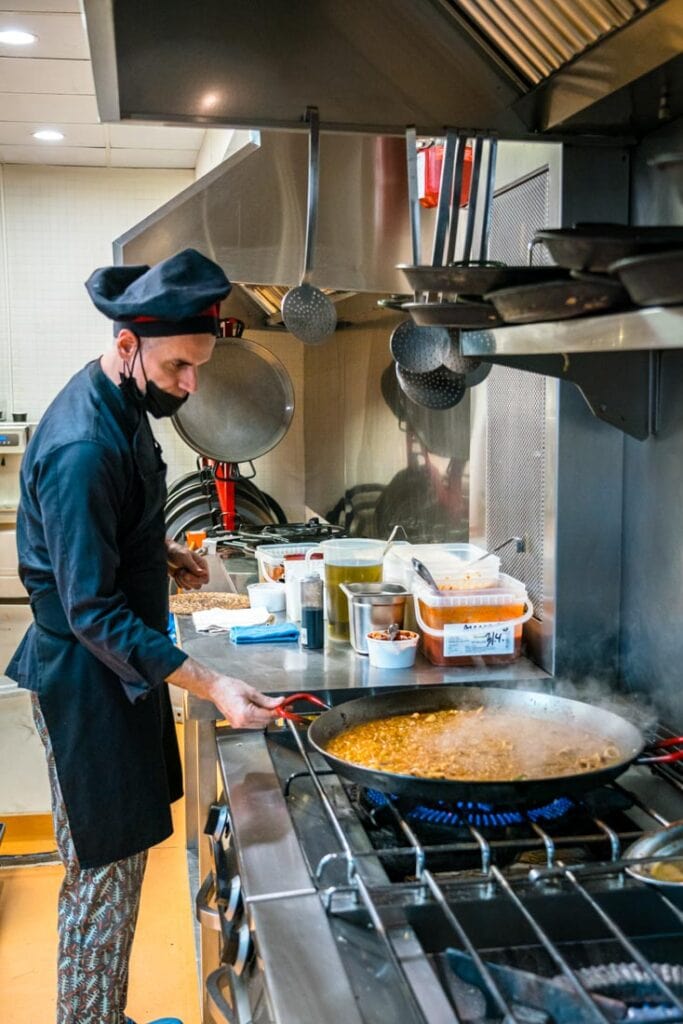
Valencia is where paella comes from, and locals are particular about it. Proper paella valenciana is made with rabbit, chicken and beans rather than seafood, cooked over wood, and eaten at lunchtime rather than in the evening.
Beyond that there’s the whole Mediterranean repertoire, plus horchata, a chilled drink made from tiger nuts and served with fartons for dipping. The rice itself is grown in the Albufera lagoon just south of the city. Food is also one of the easiest ways to practise. Ordering, asking questions and getting recommendations are all low-stakes daily reps in Spanish.
What to sort out before you go
Students from outside the EU staying longer than 90 days will usually need a Spanish student visa, which typically means proof of enrolment, accommodation, funds and health insurance. Start that process early, as appointments can be slow to come round.
On timing, September and January are the busiest intakes and summer courses fill fast. Spring and autumn are the most comfortable months to study. For a base, Ruzafa is the most popular area with younger students, El Carmen is central and lively, and Benimaclet is cheaper and full of university students.
So is Valencia the right choice?

Valencia isn’t the first city people picture when they think about studying Spanish in Spain. Madrid and Barcelona still take most of the attention.
But the maths is fairly simple. Valencia costs less, is far easier to live in day to day, and puts you in constant contact with clear, everyday Spanish. Over three months, that combination is worth a great deal more than big-city name recognition.